

Our Lodge Foundry Tour
Note: Our tour occurred in September 2018, and this blog post was written shortly thereafter but somehow never got posted. I am sure that Lodge has changed many things since our tour, as they are always at the forefront of advancement. As you read this post, bear in mind that the facts contained herein are facts that were given to me in September 2018.
The Lodge Campus
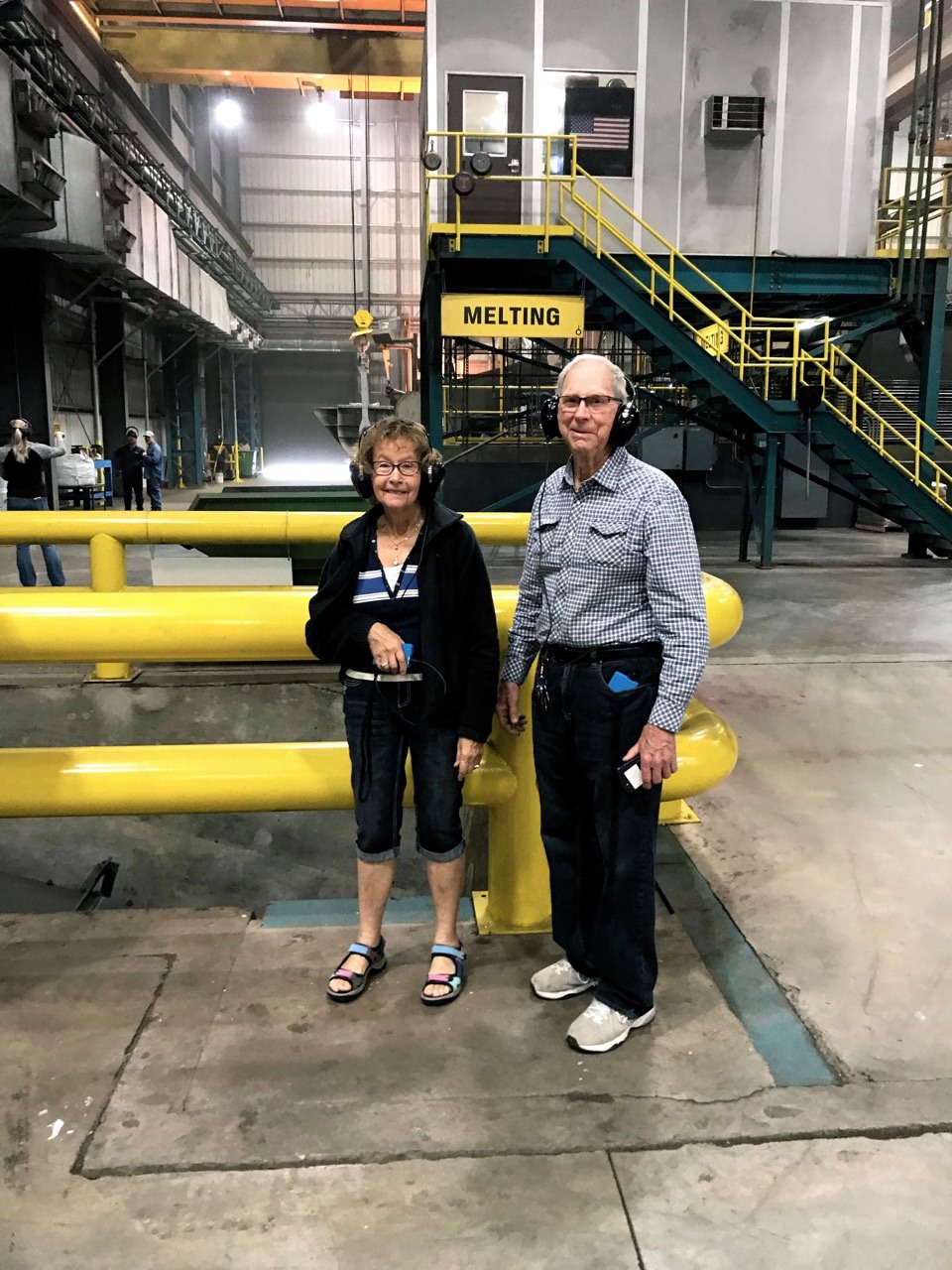
Linda and I were privileged to tour the Lodge foundry in September 2018.1 Typically, tours are offered to the public only during the annual Cornbread Festival, held the last weekend of April each year. Aside from an in-person visit, the next best thing would be a video tour. Lodge has one – you can see a foundry tour here. [/note]
Lodge has two buildings with operating foundries. They are a hop, skip and jump away from each other in the charming small town of South Pittsburg, Tennessee. The newer foundry – opened in 2017 and dubbed the 3rd Street foundry – is a 127,000 square foot expansion that increased Lodge’s potential output by 75%. As of this writing (2018), Lodge ships an average of 1 million pounds of iron product each week.

Our tour was of the 3rd Street foundry. It was led by Amanda Suttles, a Lodge Quality Auditor, and Mark Kelly, PR and Advertising Manager. Information came fast and furious during the tour; it was hard to absorb everything.
Linda and I were instructed to wear long sleeved shirts, long pants, and closed toe shoes for our tour. We were allowed to take photographs of the foundry in production except in two areas – the proprietary pattern in the DISAMATIC machine, and the proprietary seasoning process. We each had microphones we used to communicate with each other, and wore headsets so that we could hear each other speak. The foundry is very loud.
What We Saw in the Foundry
Our tour was on a Thursday at 1:00 p.m., and employees were hard at work. Linda and I had the opportunity to see the process that Lodge employs from beginning to end. We saw the raw pig iron, the mix used with the iron, and the melt. We watched a pour, and saw a worker removing slag from the red-hot iron.
We also saw the sand mix that Lodge uses to make its molds. Amanda stressed to us that the sand composition is of equal importance to the composition of the iron. In the quality control office, we watched as a technician tested the composition of the sand to ensure that it met Lodge’s standards.


We saw molten iron being poured into the sand molds, and watched as a DISAMATIC machine created cast iron grill pans from a proprietary Lodge pattern. There was a channel in each mold that permitted iron to flow into the vacant space in the sand left by the pattern.2
As of the time of writing this post, Lodge had 5 DISAMATIC – 3 in the old foundry and 2 in the 3rd Street foundry. Each DISAMATIC machine can make 350-400 molds an hour,3 and each mold may have multiple pieces.4


After the iron was poured into the sand mold, the sand was removed from the new casting by an automated shaking and then tumbling process. Pans then moved by conveyer belt to an area where they were ground by hand, removing any remnant of the gating – i.e a raised area left on a pan where the iron had been poured into the mold. At this point, the pans were a dull silver color – the color of “unseasoned” iron.


Each piece of newly-cast iron is then washed in an automated process which cycles through three cleaning processes. After, each piece continues on its way to a seasoning tunnel, where Lodge’s proprietary seasoning (soybean oil) is sprayed onto the pan. When the pans emerge after seasoning, they are the beautiful rich black color that is a hallmark of Lodge’s fine cast iron products.


After seasoning, the pans are carried by conveyor belt to an area where Lodge employees personally examine each piece; preparing for packing and shipping if deemed worthy, and scrapping if not. We saw a table in the foundry holding flawed castings from the day. The flaws were highlighted with chalk notations. Lodge’s quality control personnel examine these flawed pieces to determine what happened and how to employ a fix.

Lodge has strict quality control measures. At any stage in the manufacturing process, any employee may remove a flawed piece from the production line. Pieces with small cosmetic blemishes may end up at a Lodge Factory Store; ones with more significant defects are removed to the scrap pile.
We saw the huge scrap pile – it was amazing. I wanted to bolt in and grab pieces – that looked perfectly fine to me – and bring them home. It was not to be, however. Iron in the scrap piles are melted down and used in new pourings.


The scrap pile. It was amazing.
Post-tour Debrief
After our tour of the foundry, we had a chance to chat with Mark Kelly and Laura Candler, Senior Manager for Brand Marketing for Lodge. On the wall was a photograph of every employee of Lodge, in order of seniority.
Lodge clearly values its employees. Mark pointed out more than a handful of employees who have family members who work or have worked for Lodge. Lodge presently (2018) has 35 employees who have worked with the company for at least 25 years. Since 1951, a total of 143 employees have worked with Lodge for at least 25 years. The pattern makers – “the artists,” as termed by Mark – have long tenure. Of the three pattern makers, one has worked with Lodge for 33 years. The other two have worked with Lodge for 26 years.
Lodge’s core values and guiding principals are simple, and we saw them in action on our visit.
CORE VALUES
- Treat all people with dignity.
- Act with integrity.
- Provide stability and security for our employees and their families.
- Work safely.
- Have fun.
GUIDING PRINCIPLES
- We are committed and dedicated to the company and to each other.
- We take pride in who we are, what we do, and how we do it.
- We find ways to improve who we are, what we do, and how we do it.
- We are in this together.
Our tour was very interesting, educational, and fun. Many, many thanks to Lodge for the opportunity!
- I also toured the foundry during the 2019 Cornbread Festival with Marg and Larry O’Neil. It was so much fun to be with them on their first Lodge tour! On that visit, I had the honor of speaking about Lodge Collectors and Collections at the Collector’s Tent during the 2019 Cornbread Festival.
- Lodge has a series of short videos online that outline the process.
- An online video says that Lodge’s vertical DISAMATIC machine has put out as many as 450 molds per hour.
- Lodge has increased its output and added at least one DISAMATIC since this writing.