

Pricing Griswold’s Cast Iron Santa Molds
Griswold made beautiful cast iron cake molds – the lamb, rabbit, and my personal favorite – Santa!

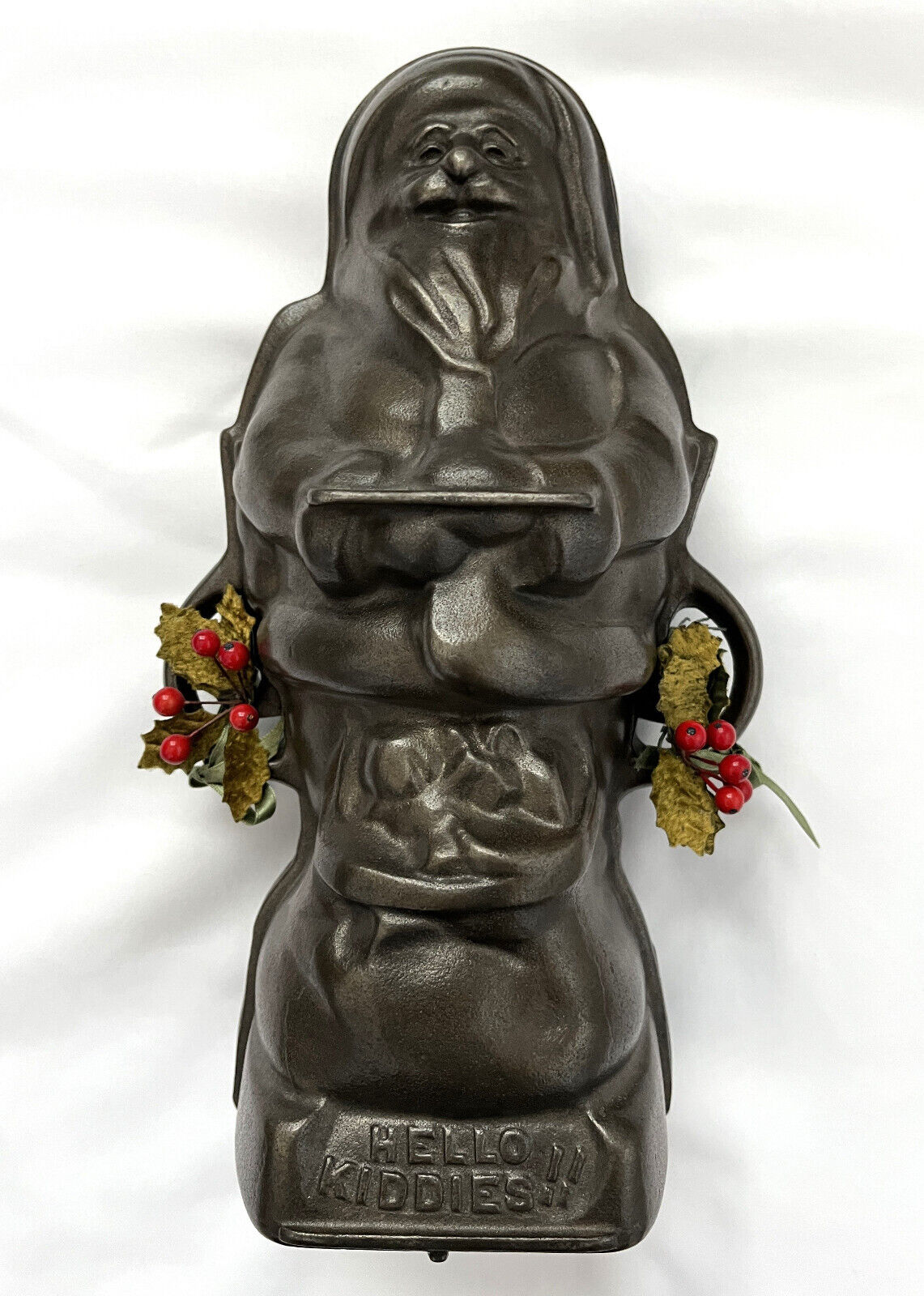
Let’s say that you are at a flea market and come across a vintage cast iron Santa cake mold. The mold features Santa holding a bag. It is marked “Griswold Mfg. Co. Erie, PA 897 and 898.” Additionally, it has “HELLO KIDDIES” printed at the base. The seller is asking $100.
Should you buy it?
If the mold is authentic, this is a great deal! However, if it is a reproduction, it is not worth the price.
The Griswold Santa cast iron cake mold was widely reproduced. I’ve written a separate blog post about how to spot the differences between an authentic and reproduction Santa mold. Making that determination is your first step.
If you determine that the Santa mold is authentic, then you need to decide whether the price – for you – is reasonable.
What’s it Worth?
Santa asking prices vary enormously. What one person considers a “reasonable” price might be an outrageous price to another person. Pricing will also be different depending on where you’re buying. You might buy your Santa from a known seller, online marketplace, auction, flea market, antique shop, garage sale, estate sale and so on.
Assuming you have concluded that the Santa is an authentic Griswold Santa, next move to:
- Condition, condition, condition
- Is it clean? Rusty? Seasoned? Is there any damage – fire damage or cracks? Any signs of repair to Santa? Significant casting flaws? (as noted in the Santa reproductions article, a vertical line on Santa’s bag is not a casting flaw – it is a result of the master pattern that was used and is a “tell” for the relative age of your Santa).
- If a piece is “as found,” it will likely be priced lower. The same is true for items at garage sales or other places where sellers don’t have to pay a fee or commission.
- If the piece is beautiful, ready to use, and well seasoned, factor in the time and equipment it took to get it that way. The seller’s time is worth money, just as is yours. The seller spent time and money sourcing the item. If the seller carefully cleaned, seasoned, and listed the piece, that cost the seller money. Equipment, time, photography, edits, listing fees, etc.
If the seller has a website, running that website costs money and time. Have you ever hired a website designer or a person who can troubleshoot problems on a website? It’s not cheap.
Hauling iron to a flea market, setting up, and working there also takes time and money. Don’t expect a wholesale price when someone has put time and money into sourcing, preparing, and presenting the item to you.
If you see an item in an antique mall or most flea markets, the seller pays for a spot. If an item is sold on eBay or Etsy, fees are taken from the sale price in addition to a listing fee. If an item is paid for with PayPal, PayPal takes a fee. If a buyer pays by credit card, a processing fee is taken from the total. If the item must be shipped, it costs the seller supplies, time, and money.
- Is it clean? Rusty? Seasoned? Is there any damage – fire damage or cracks? Any signs of repair to Santa? Significant casting flaws? (as noted in the Santa reproductions article, a vertical line on Santa’s bag is not a casting flaw – it is a result of the master pattern that was used and is a “tell” for the relative age of your Santa).
- Who is the seller and what are the terms and conditions of the sale?
- Do you know and trust the seller, or are you confident enough in your own assessment that this isn’t a concern for you?
- Will the seller accept returns? If so, and the piece needs to be shipped back, who pays the shipping cost? What are the conditions for a return? Is there a timeframe within which returns must be made?
- If the item must be shipped, Does the seller know how to properly pack cast iron for shipment? If not, be sure to clue them in! Make sure your seller insures the shipment.
- Do you know and trust the seller, or are you confident enough in your own assessment that this isn’t a concern for you?
- What is the total, walk out the door, price?
- Is there sales tax?
- If you’re buying at an auction, is there an auction premium? How much? Remember, the gavel price is not the final cost.
- What is the cost to ship and who pays for shipping? Buyer beware on shipping costs for auctions! As I said in one of my posts, I was once quoted over $100 to ship a small (i.e. 24″ x 36″) needlepoint tapestry.
- Is there a handling fee? I once read a comment where a person complained about a modest handling fee. Shipping supplies are (typically) not free, and again, it takes time to properly package an item for shipping and to bring it to the shipping facility.
- Is there sales tax?
- How badly do you want the piece, and what are you willing to pay? Scarcity + demand + condition = price.
- Is it just before Christmas and you’re desperate for a gift? Or, is it June and no one is really thinking about baking holiday cakes right now?
Haven’t you noticed that prices often go up around the holidays?
- Is it just before Christmas and you’re desperate for a gift? Or, is it June and no one is really thinking about baking holiday cakes right now?

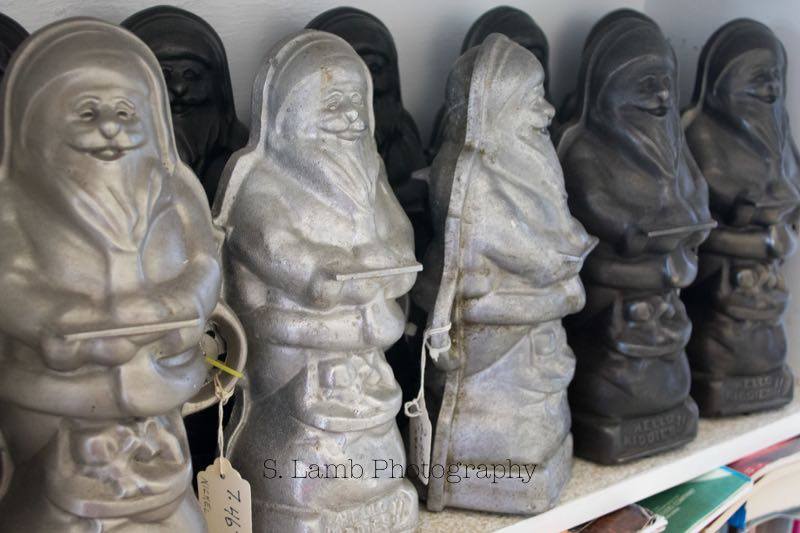
Selling Prices for Authentic Griswold Vintage Cast Iron Santa Molds
People can argue all day long about the current “value” of a piece.
If you ask 20 people what a reasonable price is, you will get a wide range of answers. Sellers might tell you a price based on what they sold the piece for or what they hope to sell it for; buyers might tell you what they bought one for or what they’d be willing to pay. Some people will offer opinions despite having no real basis for the opinion (“I heard that someone once paid…” “JMHO, but…” “I don’t really know, but I think…”). Others will simply guess, but won’t say that they are guessing.
If someone gives you an opinion, ask what the opinion is based on, and then evaluate the answer given.
In my view, the current value of a piece is what the market will bear – i.e. what a person is willing to pay. 1
To find what a person might pay for a piece – whether you are buying or selling – it helps to know what people have recently paid for a piece with the same markings in the same condition as your piece. A common way people make this determination is to look at eBay sold prices. Online auction houses also sometimes have sold prices that you can access – I have found that if I save an auction item as a “favorite” or I “watch” an item, I can often go back and later find the sale price for the piece.2
Below are some of the Santa prices I’ve seen over time. As you can easily see, prices vary widely. (My last eBay check was 9.8.26).3
What’s the Santa worth to you?4


eBay Pricing
One common method to determine the “value” of an item is by checking the prices for similar items that have recently sold on eBay. I’m not talking about what a seller is asking as a “Buy it Now” for a piece; I’m talking about the actual selling price.
The price listed as “asking price” by a seller does not necessarily reflect the true value of the item. An asking price may be unrealistically high or low, or it might be just right. It is important to distinguish between the asking price and the item’s actual value, which you can find by looking at the prices of items that have already sold.
And Still More…November 29, 2024 eBay “Sold Price” Search

I did a “sold items” search on eBay on November 29, 2024 for “Griswold Santa.” That search revealed that within the preceding 90 days, 15 authentic Santas sold on eBay for between $159 and $425.5 During that same period, 3 reproduction Santas (not identified by the seller as reproductions) sold for between $105.44 and $200. 6


November 12, 2024: $159 plus shipping, $249.99 plus shipping on November 7, 2024, $299.97 plus shipping on November 3, 2024, October 28, 2024 $217 plus shipping, Best Offer October 21, 2024 $249.99 plus shipping, $300 on October 20, 2024, $286 plus shipping on October 1, 2024, $335.99 plus shipping on September 15, 2024.
Fake sold October 21, 2024 for $149.99 plus shipping, $105.44 plus shipping on October 19, 2024.

At a 2-day cast iron cookware auction held on August 23 and 24, 2024 in Montgomery, Indiana, a lovely authentic cast iron Santa brought $200, not including the auction premium (if Santa was purchased by an online bidder as opposed to in-person) or potential shipping & handling charges.
August 17, 2024 eBay “Sold Price” Search
There were just two Griswold Santa molds that sold on eBay in the 90 days preceding August 17, 2024. Both were authentic. One sold for $190.50, and the second sold for something less than the original asking price of $195.

April 4, 2023 eBay “sold price” search
As of April 4, 2023, an authentic Griswold vintage cast iron Santa cake mold sold in the preceding 90 days for:


There you have it – now, next time you see an authentic Griswold cast iron Santa cake mold marked at a great price, you’ll be ready to pounce!
(Note: I sporadically update this post when time and energy permits.
- When I was selling, a long-time collector was apparently trying to explain to me why he thought my asking price for something was too high, saying, “But that’s what people will think it is worth!” I thought that was curious. I figured that my asking price was, indeed, what the piece was worth, as it was what people actually paid me. If the piece didn’t sell at my asking price, I recognized it was set too high, and I reduced the price until it hit the sweet spot and sold. What’s even funnier is that prices on many, if not most, well-kept cast iron pieces have risen since my selling days. I wonder if the person who made that comment to me still holds the same opinion?
- Again, though, remember that the gavel price – the high bid price – is not typically the price paid. Sales tax, shipping, handling, commission, or buyer’s premiums may be added to the high bid price.
- There was another sale for $325 + shipping as a Buy it Now” in June 2026, but I could not determine apparent authenticity from the photos, so did not include that sale. A reproduction Santa, advertised and presented as a reproduction, sold for $95 on August 23, 2025. It is unknown if there was a buyer’s premium or S&H applied on top of that price.
- At a September 2026 G&CICA auction, an authentic Santa sold for $350. Something to understand about that price, however, is that it was a “benefit” auction – i.e., the item had been donated, and the proceeds were going to the club. You will often find higher prices realized at benefit auctions.
- November 12, 2024 – $159 plus shipping, November 7, 2024 – $249.99 plus shipping, November 3, 2024 – $299.97 plus shipping, October 28, 2024 – $217 plus shipping, October 21, 2024 – $249.99 plus shipping, October 20, 2024 – $300, October 1, 2024 – $286 plus shipping, September 15, 2024 – $335.99 plus shipping.
- November 29 – best offer accepted (less than $200), October 21, 2024 – $149.99 plus shipping, October 19, 2024 – $105.44 plus shipping.